

Why New Year’s Goals Fail Without Executive Function Skills (SMARTER Goals)
The Real Problem With Resolutions
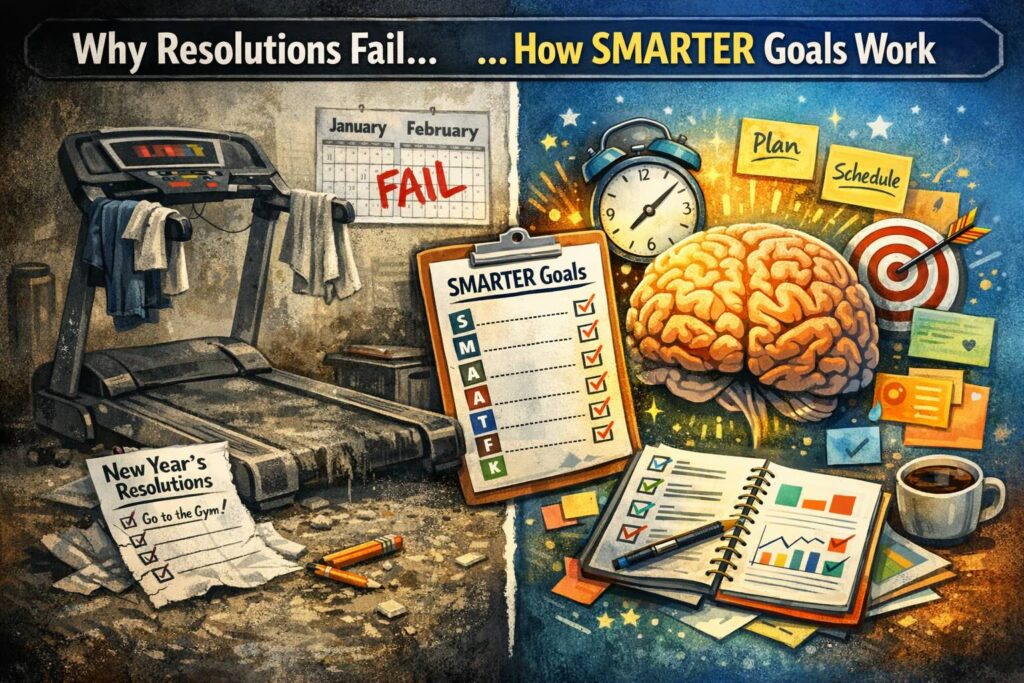
Do you want to know why New Year’s resolutions fail? First, it’s not because of laziness. They fail because people are chasing motivation instead of building a system. If motivation worked, every gym in America would still be packed by March — treadmills would be in constant use instead of serving as expensive clothes hangers.
By strengthening executive function skills, individuals can create more effective systems for achieving their resolutions.
Many people start the year with a sense of hope and possibility, eager to make positive changes in their lives. However, as the weeks unfold, the initial enthusiasm often wanes. Research shows that nearly 80% of New Year’s resolutions fail by February. A common misconception is that motivation is the key ingredient for success, but this limited perspective overlooks essential factors, including the role of executive function that contributes to lasting change.
This understanding of executive function is crucial for creating effective systems that support lasting change.
As an executive function coach, I see this pattern constantly: from middle schoolers, college students, and adults alike. People don’t struggle with wanting change. They struggle with organizing their behavior around it.
That’s where SMARTER goalscome in. Not the cookie-cutter version. The version that actually rewires how your brain approaches effort, planning, and follow-through.
The SMARTER Goal Framework
Specific
Being specific means knowing precisely what you want to achieve. Instead of vague terms like ‘improve health,’ set a particular target: ‘I will drink at least eight glasses of water daily for the next month.’ This clarity fosters a sense of direction and purpose, prompting action.
If your goal is “be healthier” or “get more organized,” your aim is too broad. Those phrases don’t trigger action.
A real goal sounds like: “Sunday at 6pm, I plan my meals for the week.”That tells your brain exactly what to do.
Measurable
If you can’t tell whether you’re winning or losing, your brain disengages.
Measurable goals allow for tangible progress tracking. Consider using a journal to record your achievements. By noting daily or weekly progress, you can see how far you’ve come, which can be incredibly motivating and help sustain your commitment over time.
Tracking the data relative to the goal removes emotion from the equation.
Achievable
Achievable goals should be realistic and tailored to your circumstances. For example, if you’re new to running, setting a goal to run a marathon within a month is likely unrealistic. Instead, aim for a 5K within three months, gradually increasing your distance and endurance. This incremental approach fosters confidence and reduces the likelihood of feeling overwhelmed.
People don’t quit because they’re weak. They quit because they set unrealistic goals.
Relevant
Recognizing the difference between essential and urgent tasks can also help prioritize goals effectively. Essential tasks contribute to long-term goals, while urgent tasks often distract us from meaningful progress. Learning to distinguish between the two can help maintain focus and motivation over the long haul.
Relevance is the difference between essential and urgent.
Time-Bound
Time-bound goals create a sense of urgency that can drive action. Instead of an open-ended commitment, set a firm deadline for each goal. For example, ‘I will finish reading three books by the end of this quarter’ establishes a clear timeframe that promotes accountability.
Open-ended goals are how we avoid commitment.
Deadlines don’t create pressure — they create clarity.
Using tools like calendars or reminder apps can reinforce time-bound commitments. Schedule regular check-ins to assess your progress and ensure you remain accountable and focused on your goals.
Time-bound goals create a sense of urgency that can drive action. Instead of an open-ended commitment, set a firm deadline for each goal. For example, ‘I will finish reading three books by the end of this quarter’ establishes a clear timeframe that promotes accountability.
Open-ended goals are how we avoid commitment.
Deadlines don’t create pressure — they create clarity.
Using tools like calendars or reminder apps can reinforce time-bound commitments. Schedule regular check-ins to assess your progress and ensure you remain accountable and focused on your goals.
Evaluate
Once a week, you look at the data, not the excuses.
Evaluation is not just about assessing outcomes but also understanding the process. Reflect on what strategies worked and which didn’t. This self-assessment is a crucial part of the learning curve and helps refine future goal-setting efforts.
This is executive functioning in action: noticing breakdowns instead of shaming yourselffor them, or, even worse, quitting.
Revising goals can sometimes be necessary to ensure they align with your evolving circumstances. If you find that a specific approach isn’t yielding results, it’s essential to remain flexible and adjust your strategy rather than abandoning the goal altogether.
You don’t quit the goal when it’s not working.
You adjust the system. That’s growth.
Revise
Revising goals can sometimes be necessary to ensure they align with your evolving circumstances. If you find that a specific approach isn’t yielding results, it’s essential to remain flexible and adjust your strategy rather than abandoning the goal altogether.
You don’t quit the goal when it’s not working.
You adjust the system. That’s growth.
Why SMARTER works for Executive Functioning
The SMARTER framework not only helps with goal-setting but also enhances overall executive function by encouraging structured thinking and planning. This systematic approach can significantly benefit individuals struggling with organization and prioritization.
At DES, we don’t believe in being lazy. We believe in broken systems.
By recognizing that broken systems lead to unmet goals, individuals can begin to identify specific areas for improvement. It’s about creating a supportive environment that promotes success, rather than solely focusing on the result.
Goals don’t fail.
People don’t fail.
The key to success lies not in the goals themselves but in the systems we establish to achieve them. Developing effective routines and habits enables individuals to navigate challenges with greater ease and consistency.
The Truth Nobody Wants to Say
New Year’s resolutions don’t fail.
People quit because they were never taught how to build goals that surpass desire.
Framework beats motivation—every time.
That’s the work of executive functioning coaching.Not motivation. Not slogans. Systems that make follow-through unavoidable.
Ultimately, the journey toward achieving goals is not a solitary one. Seeking support from coaches, mentors, or even peer groups can provide the encouragement and accountability needed to stay on track.