
AP Exams Are 10 Days Away: How to Prepare Smarter (Not Panic)

10 Days Out from AP Exams: What Actually Matters
AP exams preparations is in full swing, and here’s a reality check: you’re not learning everything from scratch at this point. You need to refine, organize, and tighten what you already know.
The biggest mistake students make right now is panic, trying to cram everything in. Face the fact that rereading entire PDFs, documents, or textbooks is like starting over, and that is time you don’t have.
At this stage, success comes down to one thing: strategy.
This is the time when maximizing your executive functioning skills, namely, test preparation, organization, and time management, comes into full swing and becomes a necessity.
For families in Greenwich, Darien, New Canaan, and Westchester, this is the stretch where the right plan can make a significant difference.
Shift Your Mindset: From Learning → Performing
With fewer than 14 days until AP Bio, Euro, and Micro, your focus should shift. Here’s what not to do:
- Learn new content
- Test your performance under pressure
Instead:
- Reinforce what you already know
- Identify weak spots
- Practice under real test conditions
At this point, the proverbial “studying smarter” beats studying longer.
Step 1: Build a “Master List” of What You Need to Know
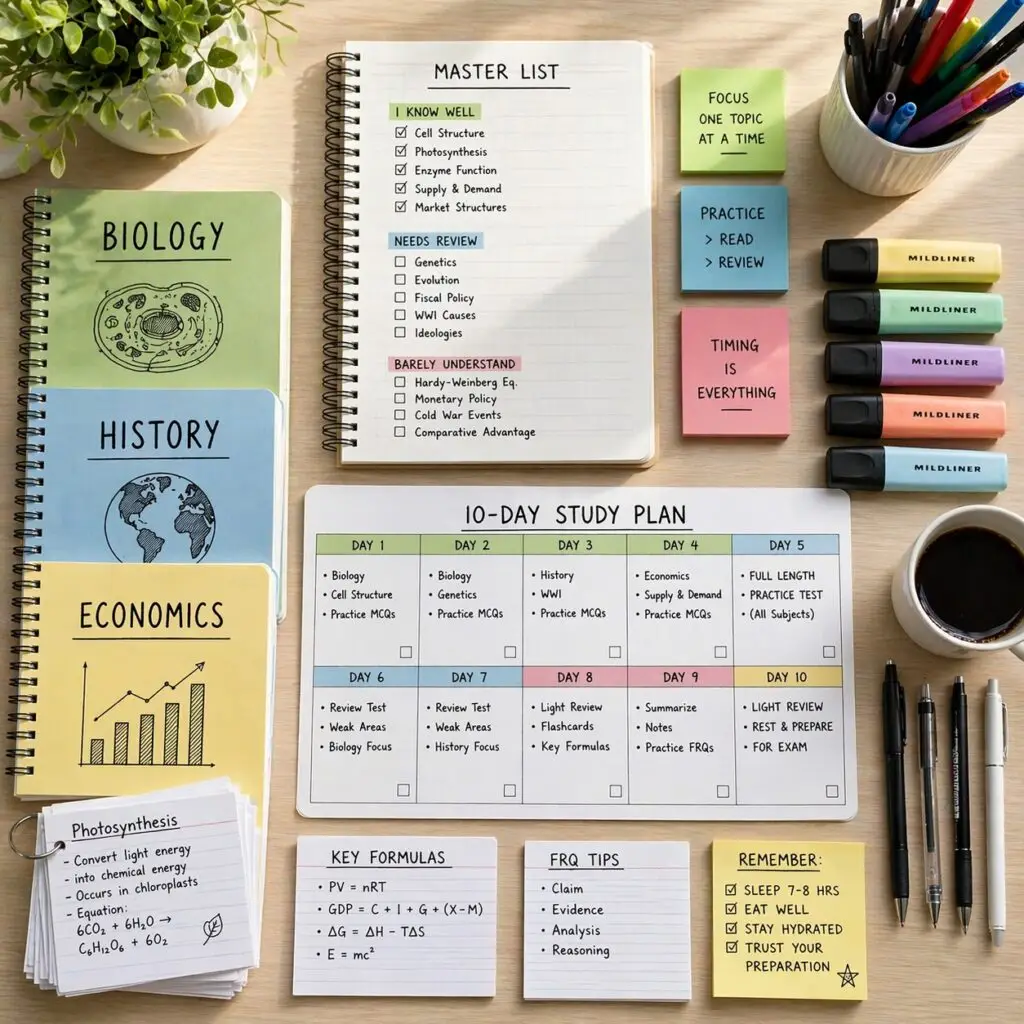
Before you touch a book, get organized.
Top-performing students don’t guess what to study, they map it out.
Pull from:
- Your teacher’s syllabus
- AP topic lists from the College Board
- Old tests, quizzes, and notes
Then create one master list of:
- What you know well
- What needs review
- What you barely understand
This turns a year’s worth of content into something manageable.
Step 2: Focus on High-Yield Topics (80/20 Rule)
You do NOT have time to cover everything equally.
If you’re short on time:
- Spend 80% of your time on major topics
- Spend 20% on smaller details
AP exams are predictable in structure and weighting. Prioritizing the most tested material gives you the biggest return. Again, the definition of studying smarter means being efficient in your approach.
Step 3: Practice > Reading (Non-Negotiable)
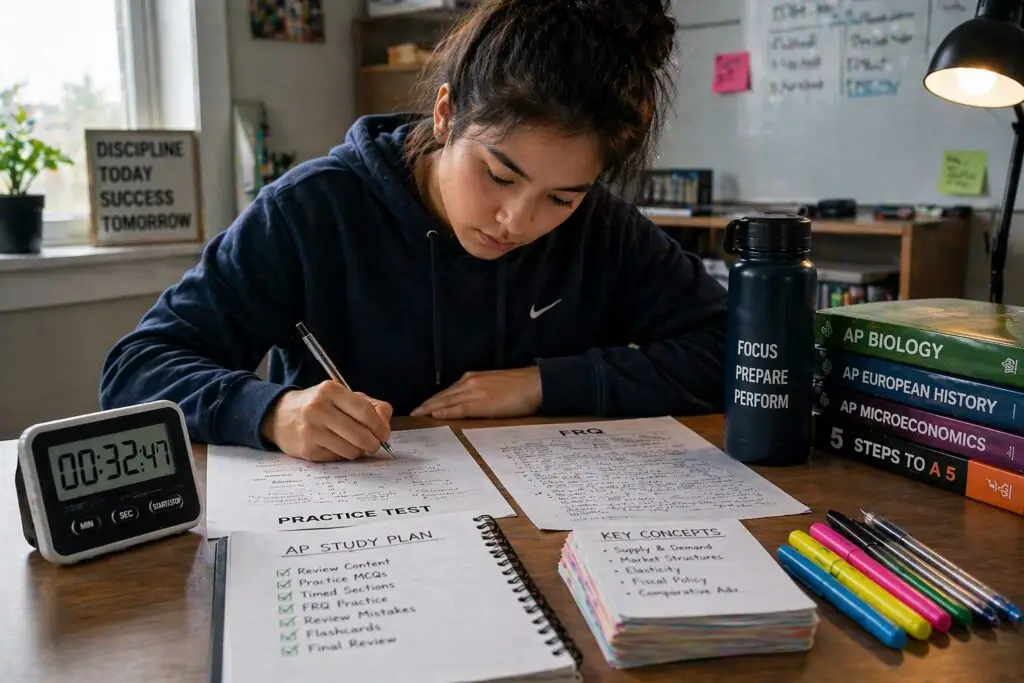
If you’re still mostly reading notes, you’re wasting time.
In the final stretch:
- Do practice questions
- Complete timed sections
- Outline essays
This is where real improvement happens.
Practice exposes:
- Content gaps
- Timing issues
- Misunderstanding of questions
And that’s exactly what you need to fix right now.
Remember: this is not time for a reset; it’s an opportunity for refinement.
Step 4: Simulate the Test (Timing is Everything)
A lot of students know the material, but run out of time.
That’s a problem.
Start:
- Timing MCQ sections
- Practicing FRQs under pressure
- Learning when to move on from a question
It’s better to answer everything at 80% than leave 20% blank.
Step 5: Identify Weak Areas, and Attack Them
This is not the time to review what feels comfortable. That would be a waste of time, time is a luxury that you don’t possess anymore.
Review:
- Practice test results
- Incorrect answers (or lucky guesses)
- Topics you avoid
Then go directly at those. Again, targeted review is far more effective than re-reading everything.
Step 6: Create a Simple 10-Day Plan
You don’t need a perfect plan, you need a realistic one.
Also, remember that you’ll have other responsibilities, such as homework. The day that teachers factor in the stress and sheer time commitment of studying for AP exams is the day when pigs can fly.
You will also have to contend with extracurricular activities, family obligations, sports, and more.
That said, use this plan:
Example structure:
Days 1–4
- Review major topics
- Light practice questions
Days 5–7
- Full practice tests
- Focus on weak areas
Days 8–9
- Light review
- Flashcards/summaries
Day 10 (Before Exam)
- Minimal review
- Rest and reset
Remember, cramming everything the night before will hurt more than help. It’s like trying to force an extra gallon of gas into a full tank. Some might get in, but you’re pushing out other useful material.
This is especially important for students balancing demanding schedules, which we commonly see with students throughout Greenwich, Darien, New Canaan, and Westchester.
Step 7: Organize Your Materials (Fast)
You should not be flipping through five notebooks the night before.
Pull everything together:
- Notes
- Practice tests
- Key concepts
- Formulas/vocab
Condense it into:
- One outline
- One study sheet
- Or one set of flashcards
The process of organizing is studying.
Step 8: Don’t Ignore the Rubric (Especially for Essays)
For writing-based AP exams preparation (English, History, Gov):
Rubrics tell you exactly how to earn points.
That means:
- Clear claim
- Specific evidence
- Direct analysis
You’re not writing for your teacher, you’re writing for a paid grader who follows a checklist. Make sure you follow the same rubric they use.
A good teacher will help you walk through this process throughout the school year. If you are unsure, ask your teacher.
Step 9: Avoid These Last-Minute Mistakes
In the final 10 days, avoid:
- Re-reading entire textbooks
- Trying to learn completely new units
- Pulling all-nighters
- Studying without a plan
- Ignoring timing
- Comparing yourself to other learners (everyone is different)
These are the habits that lead to underperformance, even for the strongest students.
Step 10: Prepare for Test Day (This Matters More Than You Think)
The night before:
- Get 7–8 hours of sleep
- Lay out materials (calculator, pencils, ID)
- Eat a solid meal (low sugar and carbs, you can’t afford to crash)
Students who are rested and calm perform significantly better than those who are burnt out.
Key Takeaways
- You are no longer learning, you are preparing to perform
- Practice tests matter more than reading
- Focus on high-yield topics
- Target weak areas directly
- Timing can make or break your score
- A simple, consistent plan beats panic
Need Help in the Final Stretch?
At this stage, small adjustments can make a big difference.
At Diversified Education Services, we help students across Greenwich, Darien, New Canaan, and Westchester identify exactly what to focus on, improve timing and test strategy, build structure in the final days, and reduce stress while increasing confidence.
- Identify exactly what to focus on
- Improve timing and test strategy
- Build structure in the final days
- Reduce stress and increase confidence
For many students, this is the difference between walking in unsure and walking in ready.
Book a free consultation to build a focused plan for the next 10 days.
Explore More DES Resources