
Executive Function Coaching for Elementary Students
Your seven-year-old reads chapter books meant for twelve-year-olds, then dissolves over writing two sentences. The mind is extraordinary. The morning routine is a daily battle. Both things are true, and both make sense.
Diversified Education Services provides gentle, age-appropriate executive function coaching for elementary students in Greenwich, CT, Westchester County, NY, Manhattan, and Boca Raton, FL, and online. We work with children in grades 1-5, with a particular specialty in very bright young kids whose self-management skills haven’t caught up with their ideas.
Schedule a Complimentary Consultation →
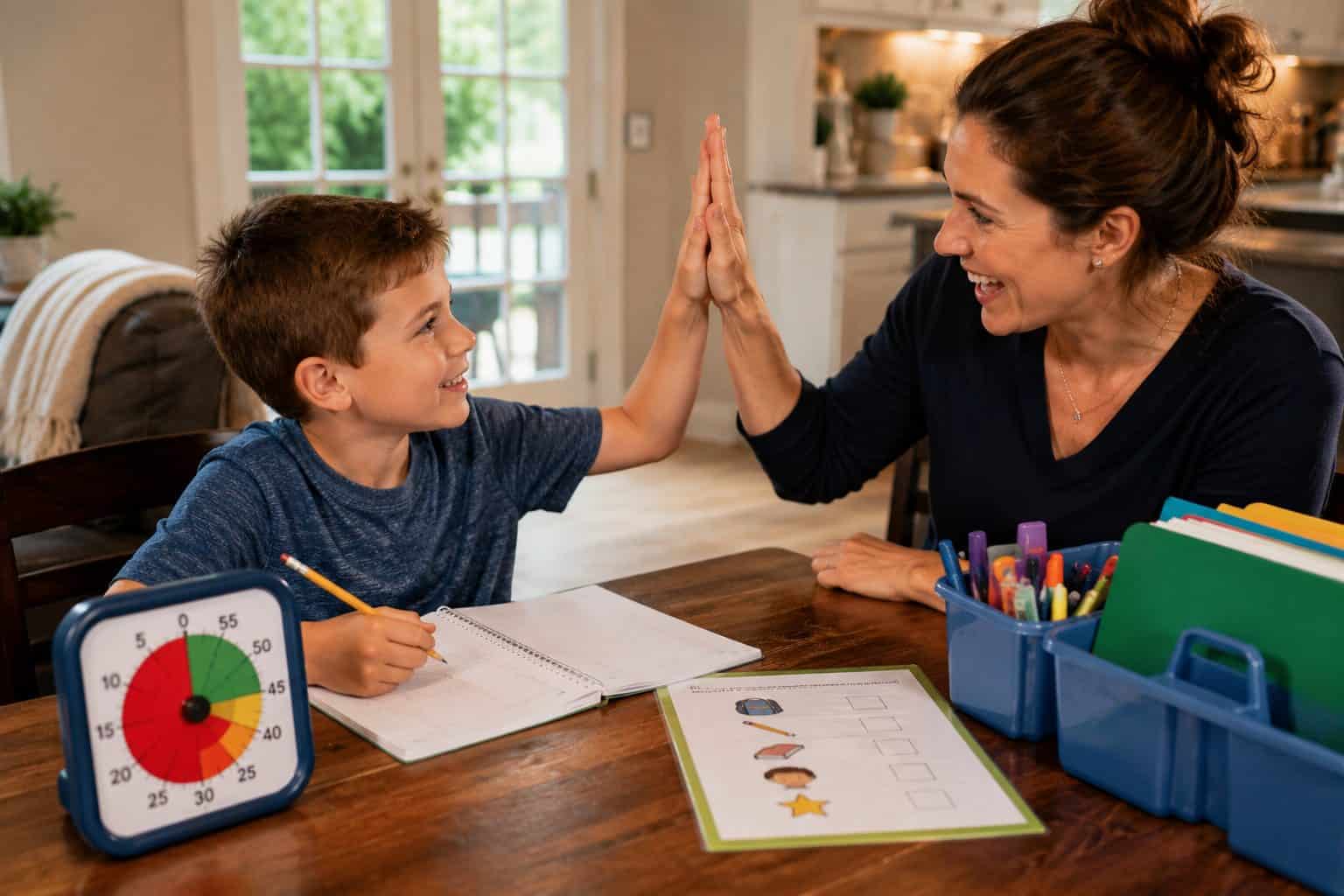
Very Bright, Very Young, and Already Out of Step
Parents of exceptionally bright young children often describe the same bewildering pattern. The vocabulary of a much older child, an insatiable curiosity, ideas that stop adults mid-sentence, alongside meltdowns over a worksheet, a folder that eats every permission slip, homework that takes ninety minutes of negotiation and nine minutes of work.
Child development specialists have a name for this: asynchronous development. A child’s intellect and their self-management skills grow on separate timelines, and in gifted children the space between the two is often at its widest. A second grader can carry a fifth grader’s mind and a first grader’s executive function at the same time. That mismatch isn’t a behavior problem or a discipline problem, but it produces daily friction that looks like one, and bright children feel that gap sharply. Many are already deciding, at seven or eight, that something is wrong with them.
Some of the children we work with have a diagnosis, ADHD most commonly, sometimes a learning difference alongside remarkable gifts (twice-exceptional, or 2e). Many have none. Either way, the work is the same: build the missing skills, playfully and early, before frustration hardens into a story the child tells about themselves.
Isn’t Coaching for Older Kids?
The word “coaching” brings teenagers to mind, so the question is fair. But executive function skills, which include starting a task, sticking with it, keeping track of things, and managing big feelings about hard work, begin developing in early childhood, and the habits formed in elementary school are the foundation everything later stands on. Early support is also the cheapest win in education: a routine that takes a month to build at seven can take a year of undoing at fifteen.
What changes at this age isn’t whether coaching works. It’s what coaching looks like: shorter sessions, games and visual tools instead of planners and lectures, and parents as full partners rather than observers.
Who We Work With
- Gifted and high-ability young children: kids whose ideas outrun their ability to organize, start, and finish
- Twice-exceptional (2e) children: exceptional ability alongside ADHD, a learning difference, or big emotions
- Children with ADHD: with age-appropriate coaching that builds skills without shame
- Kids with no diagnosis at all: where mornings, homework, and transitions are simply much harder than they should be
- Families exhausted by the daily battles: homework standoffs, lost folders, and routines that only run when a parent runs them
What Executive Function Coaching for Elementary Students Looks Like
- Homework routines that end the nightly battle: a predictable time, place, and sequence, sized to the child
- Task initiation, made small: starting in tiny steps, with games and timers, so beginning stops being the hardest part
- Breaking work down: turning “write about your weekend” from an impossible cliff into three small stones
- Keeping track of things: simple, visual systems for folders, backpacks, and belongings
- Big feelings about hard work: frustration tolerance and the beginnings of perfectionism, which shows up startlingly early in gifted kids
- Confidence: the quiet, central goal: a child who believes hard things are startable
Parents Are Part of the Plan
With elementary-aged children, coaching the child alone is half a solution. Routines live at home, so we work closely with you: what to prompt and what to stop prompting, how to praise process instead of brilliance (gifted kids especially need this), and how to hand over responsibility one small piece at a time. Many parents tell us this guidance changed the household weather as much as it changed the homework.
When a child also needs help with reading, writing, or early math skills, our Reading and Writing Tutoring and Academic Tutoring programs pair naturally with coaching, often with the same familiar person.
Why Families Choose DES
DES has worked with bright, struggling students since 2009, and our coaches are professional educators who genuinely enjoy this age: patient, playful, and unfazed by a child who negotiates like a lawyer. Founder Aron Boxer, M.Ed., S.P.E., is a Forbes Coaches Council member. We hold the same conviction with a seven-year-old that we hold with a seventeen-year-old: this is a capable person missing a skill, not a problem child. We don’t believe in “lazy” at any age.
Related Resources
- Executive Function Coaching: our core coaching page
- Executive Function Coaching for Middle School Students: what comes next
- Parent Success Center: free guides on homework battles, morning routines, and organization at home
- Reading and Writing Tutoring: structured literacy support for elementary students
Executive Function Coaching for Elementary Students: FAQs
Is my child too young for this?
If daily life with homework, mornings, and transitions regularly ends in conflict or tears, your child is old enough to be helped. We adapt everything about coaching to the age: session length, tools, tone, and how much runs through you as the parent.
My child is in the gifted program. Why is school so hard?
Because school is only partly an intelligence test. It is also, every day, a test of starting, finishing, tracking, and tolerating frustration, skills that develop separately from intellect and often lag furthest behind in the brightest kids. The gap is developmental and it closes, faster with support.
Do we need an ADHD diagnosis or testing first?
No. Coaching requires no diagnosis, and starting coaching doesn’t interfere if you pursue testing later. If your child already has a diagnosis or a school support plan, we coordinate with it.
What does a session with a young child actually look like?
Short, structured, and warm. A check-in, one skill worked on through the child’s real homework or a game built around it, and a small, specific plan for the week that parents help support. Sessions are typically shorter than our teen sessions, in person or online.
How is this different from tutoring?
Tutoring builds academic skills: reading, writing, math. Coaching builds the skills around the academics: starting, focusing, finishing, keeping track. Many bright young kids need the second far more than the first. When both are needed, we combine them.
How long does it take to see change?
Families usually see friction drop within the first few weeks as routines take hold. Durable, child-owned habits take longer, typically a school semester, and we’ll always tell you honestly where things stand.
What ages and grades do you work with?
Grades 1 through 5. The youngest children meet for shorter sessions with more of the plan running through a parent; by fourth and fifth grade, the student is doing more of the tracking and planning independently, which is what middle school will expect. See our executive function coaching for middle school students for what comes next.
Can coaching help with mornings and getting out the door?
Yes. Morning routines are one of the first things we build with young children, because a calm morning changes the whole day. The coach sets up a short, visual sequence the child can follow and shows you what to prompt and what to stop prompting. Our guide to morning routine problems has the at-home version.
Is coaching for young children in person or online, and where?
Both. In-person coaching is available in Greenwich, CT, Westchester County, NY, Manhattan, and Boca Raton and Palm Beach County, FL, and families anywhere can work with us online; online sessions are kept short and hands-on for this age, and work well when a parent is nearby to help with materials.
Get Started
The earlier a bright child learns that hard things are startable, the more of their potential stays intact. A free twenty-minute consultation will give you a clear read on whether executive function coaching for elementary students fits your child and what we’d build first.