
Executive Function Coaching vs. Tutoring: Which Does Your Child Need?
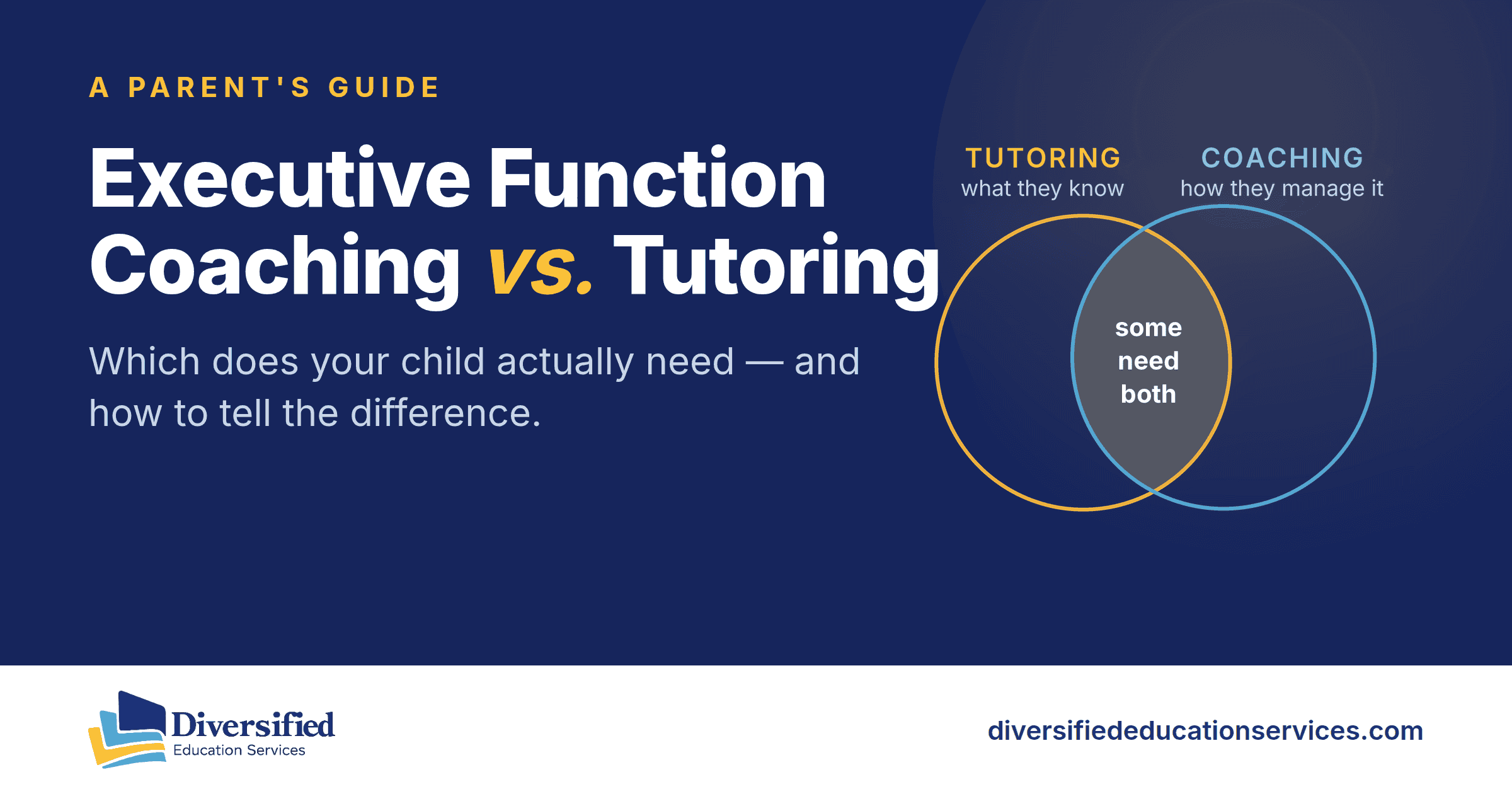
Tutoring reteaches the material; executive function coaching builds the systems to manage it.
When a student starts struggling in school, tutoring is often the first solution parents consider. Sometimes that’s exactly what the student needs. But after working with students and families for years, I’ve also seen plenty of situations where adding more tutoring doesn’t address the actual problem.
A student can understand algebra and still forget to submit the homework. A strong writer can put off an essay until 10 p.m. the night before it’s due. A high-achieving student can maintain good grades while spending four hours every night doing work that should take half that time. In each of these situations, the problem may have very little to do with understanding the academic material.
That’s where the distinction between executive function coaching and tutoring becomes important. Tutoring primarily addresses what a student knows and understands. Executive function coaching focuses on how a student manages what they have to do: planning, organization, time management, task initiation, prioritization, studying and follow-through.
At Diversified Education Services, we provide both executive function coaching and academic tutoring, and we don’t view the two as competing services. The first question is much simpler: Where is the breakdown occurring? Is this primarily a knowledge problem, an execution problem, or some combination of the two?
Executive Function Coaching vs. Tutoring at a Glance
| If the student struggles with… | A good starting point may be… |
|---|---|
| Understanding algebra or another specific subject | Academic tutoring |
| Reading comprehension | Academic tutoring |
| Essay structure or writing skills | Academic tutoring |
| Preparing for a difficult exam | Academic tutoring |
| Keeping track of assignments | Executive function coaching |
| Procrastination | Executive function coaching |
| Starting homework | Executive function coaching |
| Time management | Executive function coaching |
| Planning long-term assignments | Executive function coaching |
| Organization | Executive function coaching |
| Following through independently | Executive function coaching |
| Both the material and managing the workload | Both |
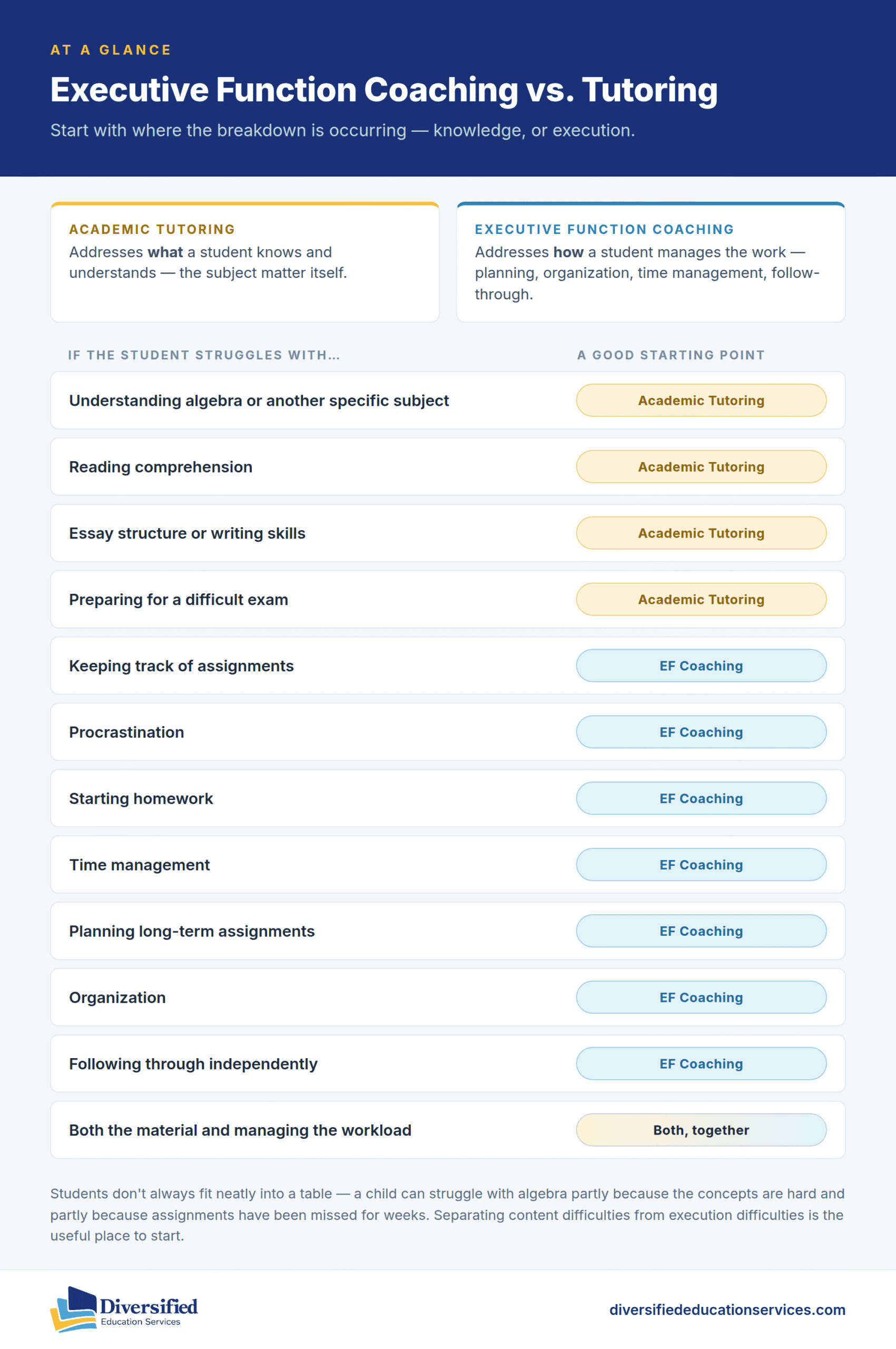
Students don’t always fit neatly into a table, of course. A child may be struggling with algebra partly because the concepts are difficult and partly because assignments have been missed for three weeks. Still, separating content difficulties from execution difficulties gives parents a useful place to start.
What Is Academic Tutoring?
Academic tutoring focuses primarily on subject matter and academic skills. If a student doesn’t understand quadratic equations, a math tutor can reteach the concept, identify gaps in understanding and provide additional practice. If a student struggles to organize an essay because they haven’t mastered thesis development, paragraph structure or supporting evidence, a writing tutor can teach those skills directly.
The same principle applies to reading, chemistry, physics, history, foreign language and other subjects. A good tutor is trying to determine what the student doesn’t understand yet, why the student is having difficulty with it, and what instruction will help close that gap.
This is important because students cannot organize their way out of a genuine knowledge deficit. If a student truly doesn’t understand the math, putting every assignment into a perfectly organized planner isn’t going to solve the underlying problem. That student needs someone who can teach the math.
What Is Executive Function Coaching?
Executive function coaching focuses on a different part of academic performance. Instead of primarily teaching content, a coach helps a student develop the systems and habits needed to manage responsibilities more independently. That can include planning, organization, time management, task initiation, prioritization, working memory, self-monitoring, study strategies and breaking larger assignments into manageable steps.
A coaching session might begin by looking at the student’s actual school portal, calendar or assignment list. Instead of simply asking, “What’s your homework tonight?” the conversation becomes broader. What’s due tomorrow? What’s coming later this week? There’s a history test Friday, so when are you actually going to study for it? There’s a paper due next Tuesday, so what needs to happen between now and then?
The student’s real academic work becomes the vehicle for developing these skills. The goal isn’t simply to get tonight’s homework finished. It’s to help the student develop a process that can eventually be used without the coach sitting there. Over time, effective executive function coaching should lead to less dependence on adults, not more.
The Real Question: Is It a Knowledge Problem or an Execution Problem?
This is one of the most useful distinctions parents can make. A knowledge problem often sounds like, “I don’t know how to do this.” The student may be organized, may have started the assignment on time and may genuinely be putting in the effort, but the material isn’t making sense. That’s when subject-specific tutoring may be the appropriate intervention.
An execution problem is different. The student may understand exactly what needs to be done but have trouble consistently getting it done. They procrastinate, forget assignments, underestimate how long work will take, fail to check the school portal, lose track of deadlines or wait until a manageable assignment becomes an emergency. Teaching more academic content doesn’t necessarily address any of those problems.
Then there’s the third possibility: the student doesn’t understand the material and isn’t managing the workload effectively. That’s where tutoring and executive function coaching can work together. In fact, academic and executive function problems frequently compound each other. A student who doesn’t understand chemistry may start avoiding chemistry homework. The avoidance creates missed practice and additional knowledge gaps, which makes the class feel even more overwhelming and leads to more avoidance.
Simply calling that student “disorganized” misses half the problem. Simply giving that student chemistry tutoring may miss the other half.
Signs Your Child May Need Executive Function Coaching
One of the clearest signs is a gap between what a student appears capable of doing and what actually gets completed. The student may participate well in class and perform well on tests, yet homework is missing and assignments are late. If the student knows the material, providing more instruction in that material may not change the outcome.
Another sign is the amount of parental involvement required to keep school functioning. If evenings are filled with questions like “Did you check the portal?”, “What’s due tomorrow?”, “Did you study?” and “Did you put that in your backpack?”, the problem may have become less about academics and more about independence. Parents naturally provide structure, particularly for younger students, but that structure should gradually transfer to the student as they mature.
Procrastination is another common indicator. Some students become surprisingly good at using urgency as their primary way of getting things done. They wait until the pressure becomes uncomfortable enough to force themselves into action, and because they sometimes manage to pull it off, the pattern continues. The problem is that academic demands eventually become too large for this strategy to work reliably.
Parents should also pay attention to how much effort is required to produce the grades they’re seeing. A student earning A’s is not necessarily functioning efficiently. If a capable student spends most of the evening doing homework, constantly gets distracted, routinely stays up too late or requires significant adult intervention to maintain those grades, the report card may be hiding an executive function problem.
Long-term assignments are another useful test. A student may know about a project for three weeks but mentally treat it as though it doesn’t exist until the deadline is close. Turning a distant deadline into concrete steps that happen over several days or weeks requires planning, time awareness and task initiation. Those are executive function skills.
Finally, look for patterns across classes. If the same missed assignments, poor planning and procrastination are showing up in English, science, history and math, hiring four different tutors probably isn’t the first solution I would consider. The common denominator is worth examining.
Signs Your Child May Actually Need a Tutor
Executive function coaching isn’t the answer to every academic struggle, and we shouldn’t pretend that it is. If a student’s difficulty is concentrated in one subject while everything else is going reasonably well, tutoring may be the obvious place to start. A student who is organized, completes work on time and performs well everywhere except algebra may simply need a strong algebra tutor.
Tutoring is also important when foundational academic skills are missing. This is especially true in cumulative subjects such as math, reading and writing, where current difficulties may be connected to material the student never fully mastered months or even years earlier. No amount of time-management coaching can replace explicit instruction when a genuine academic gap exists.
Effort is another clue. If a student starts assignments on time, studies appropriately, seeks help, completes the work and still cannot understand the material, that looks very different from a student who repeatedly begins studying at midnight. Specialized academic needs can also require specialized instruction. A student with significant reading or writing difficulties, for example, may benefit from a trained reading specialist rather than general homework support.
What If My Child Gets Good Grades but Is Completely Disorganized?
This is a situation parents sometimes overlook because the report card suggests that everything is fine. A parent will tell me, “But he’s getting A’s.” My next question is usually some version of: What does it take for him to get those A’s?
If a student earns excellent grades but routinely stays awake until 1 a.m., needs constant reminders from a parent, forgets assignments and spends far more time than necessary completing schoolwork, the grades aren’t telling the whole story. Academic success and efficient executive functioning are not the same thing.
Bright students can compensate for weak executive function skills for a surprisingly long time. Intelligence, memory and parental structure can cover up a lot when the workload is manageable. Eventually, though, students encounter more classes, longer assignments, multiple teachers and greater expectations for independence. The system that worked in seventh grade may start breaking down in tenth grade, and the system that got a student through high school may not survive the first semester of college.
Parents don’t necessarily need to wait for the grades to collapse before paying attention to the process behind them.
Executive Function Coaching vs. Tutoring for Students With ADHD
Students with ADHD frequently experience difficulties with executive skills, but an ADHD diagnosis does not automatically answer the tutoring-versus-coaching question. The same basic principle still applies: look at where the student is actually struggling.
A student with ADHD who doesn’t understand geometry may need a geometry tutor. Another student with ADHD may understand geometry perfectly well but repeatedly forget assignments, procrastinate, mismanage time and fail to prepare for tests. Executive function coaching may be a better fit for that student. A third student may genuinely need both.
This is why I don’t like reducing a student to a diagnosis. Two students with ADHD can present very differently. A diagnosis gives us useful information, but the student’s actual behavior, strengths and areas of difficulty tell us what needs to be addressed.
Related reading: Executive Function Coaching vs. ADHD Coaching.
Can Executive Function Coaching Include Homework Help?
Yes, and in many cases the student’s actual homework should be part of the process. There is an important difference, however, between using homework to teach executive function skills and simply helping a student get tonight’s homework done.
Real assignments give coaches something meaningful to work with. Tomorrow’s English assignment can become an opportunity to practice task initiation. Next week’s science test can be used to teach backward planning and better study habits. A research paper can become an opportunity to break a large project into smaller steps, estimate how long those steps will take and decide when each one will happen.
Getting the assignment completed matters, of course, but it isn’t the only objective. The larger question is whether the student is learning a process that can be repeated the next time the coach isn’t there.
Can an Executive Function Coach Also Tutor?
Sometimes, and this is one area where the distinction between executive function coaching and tutoring becomes less black and white. An experienced educator may be able to provide academic support while simultaneously helping a student improve planning, organization and study strategies. For the right student and coach, that combination can be very effective.
There are limits, though. Nobody is an expert in every academic subject. A high school student taking AP Calculus, AP Chemistry or another advanced course may need a subject specialist even if the student’s executive function coach is an experienced teacher.
Instead of getting hung up on whether someone should be called a “tutor” or a “coach,” I think the better question is: What does this particular student need from the person sitting across the table?
Can a Student Need Both Tutoring and Executive Function Coaching?
Absolutely. Consider a tenth grader who understands the material and performs well on tests but regularly misses homework, starts assignments late and requires a parent to get them moving. That’s primarily an execution issue, so executive function coaching would be a logical place to start.
Now consider an eighth grader who records every assignment, studies consistently and turns everything in on time but cannot understand the current algebra unit despite putting in the effort. That’s a much clearer case for academic tutoring.
A third student might be struggling in chemistry, falling behind on assignments and becoming so overwhelmed that they now avoid the class entirely. That student may need both content support and executive function coaching. Addressing only the chemistry might leave the avoidance and planning problems untouched, while addressing only the organization could leave the student organized but still unable to understand the chemistry.
There’s also the high-achieving student whose grades look terrific from the outside. A student at a demanding school may be earning A’s while chronically underestimating how long assignments will take, staying up far too late and struggling to prioritize competing responsibilities. That student may not need a tutor at all. They may need a better system.
What Should Executive Function Coaching Actually Accomplish?
The objective isn’t to create a perfectly organized student who functions well only when a coach is present. The objective is independence. As students develop stronger executive skills, they should become increasingly capable of determining what needs to be done, deciding when to do it, estimating how long it will take and adjusting when the original plan doesn’t work.
That progress isn’t always perfectly linear. Students are going to forget things, underestimate an assignment or have a bad week. Adults do the same thing. The point isn’t perfection; it’s helping students develop enough awareness and enough practical strategies that one mistake doesn’t turn into a week of missed work.
These skills also extend well beyond a particular class or report card. The ability to plan, prioritize, initiate tasks, manage time and recover when things don’t go according to plan becomes increasingly important in college and eventually in the workplace.
How DES Approaches Executive Function Coaching and Tutoring
At Diversified Education Services, we don’t start from the assumption that a struggling student is lazy or simply needs to try harder. If a capable student repeatedly isn’t doing what teachers and parents know they’re capable of doing, there’s usually a reason. Our job is to figure out what is getting in the way and determine what kind of support makes sense.
Sometimes that’s executive function coaching. Sometimes it’s academic tutoring. Sometimes it’s both. Our executive function coaches work individually with students on practical skills such as planning, organization, time management, task initiation, prioritization, study habits and accountability, using the student’s actual responsibilities whenever possible.
When the problem is academic content, DES also provides one-on-one tutoring across a range of subjects and levels. And when a student needs both academic and executive function support, those services don’t have to exist in separate worlds. A strong educational professional should be able to recognize when a student needs help with the material, when the problem is how the student is managing the material, and when another specialist should be brought in.
The goal isn’t to fit a student into one of our services. It’s to determine what’s getting in the student’s way and help them move forward.
How Do I Know Which One My Child Needs?

Start with what you’re actually observing rather than the label you think your child needs. Does your child understand the material? If not, tutoring may be the appropriate starting point. Can your child independently keep track of assignments, start work at a reasonable time and plan ahead? If not, executive functioning may be part of the problem.
Also look at whether the difficulty is isolated or widespread. One struggling subject may point toward tutoring, while a pattern of procrastination, missed work and poor planning across several subjects is more suggestive of an executive function issue. Neither rule is absolute, which is why looking at the entire student matters.
And if both are happening, don’t force yourself to choose one. Students are complicated. The right support should address the actual problem rather than whichever service happens to have the most familiar name.
Frequently Asked Questions About Executive Function Coaching vs. Tutoring
Is executive function coaching the same as tutoring?
No. Tutoring generally focuses on understanding academic content or strengthening skills in a particular subject. Executive function coaching focuses on the processes students use to manage their work, including planning, organization, time management, task initiation, prioritization, studying and follow-through.
Does my child need a tutor or an executive function coach?
If your child is organized and working consistently but doesn’t understand a particular subject, tutoring may be the better choice. If your child understands the material but struggles to start, organize, plan or complete work consistently, executive function coaching may be more appropriate. Some students need both, particularly when falling behind academically has also led to avoidance or poor work habits.
Can executive function coaching help with homework?
Yes. Homework provides real opportunities to practice planning, task initiation, time management and organization. The difference is that homework completion shouldn’t be the only goal. A good coach uses the work in front of the student to teach strategies that can eventually be used independently.
Is executive function coaching helpful for students with ADHD?
It can be. Many students with ADHD struggle with executive skills such as task initiation, organization, time management and follow-through. However, support should be based on the individual student’s needs rather than assuming that every student with ADHD requires the same intervention.
Can an executive function coach also be a tutor?
Yes, depending on the coach’s academic background and the level of the coursework. An experienced educator may be able to combine executive function coaching with academic support, while advanced or highly specialized subjects may require a separate subject-area specialist.
What age is appropriate for executive function coaching?
Executive function skills can be developed at many ages, but coaching should look very different for an elementary student than it does for a high school or college student. Younger students generally need simpler systems and more adult scaffolding, while older students should take progressively greater ownership of planning, organization and follow-through.
Can a student need both tutoring and executive function coaching?
Yes. A student can have a genuine knowledge gap while also struggling with organization, planning or procrastination. In those situations, addressing only one side of the problem may leave the other unresolved.
How do I know if executive function coaching is working?
Don’t look only at grades. Look for changes in behavior and independence. Is the student checking assignments without being told? Starting earlier? Planning ahead? Missing fewer deadlines? Recovering more effectively when something goes wrong? Those behavioral changes can be important indicators of progress, sometimes before a significant change appears on a report card.
The Bottom Line
The difference between executive function coaching and tutoring ultimately comes down to what is preventing the student from succeeding. If the primary problem is knowledge or understanding, academic tutoring may be the right starting point. If the student understands the material but struggles to organize, initiate, plan and follow through, executive function coaching may be more appropriate.
And sometimes the answer is both. What matters most isn’t what the service is called; it’s whether the person working with your child understands what’s actually getting in the way and knows how to help the student become more capable and independent.
Not sure whether your child needs executive function coaching, academic tutoring or a combination of both? Contact Diversified Education Services to discuss what you’re seeing and determine the best starting point.